When it comes to painting in modern art, abstractionism is perhaps the most incomprehensible school: are these works randomly applied or carefully designed? What does the constant splicing and recombination of geometric shapes describe? In fact, in terms of the purpose of abstraction, its content is closest to the essence of art. Their theories may be very jerky; however, only by analyzing the picture itself can one touch on many questions about the "essence of art" about what they are trying to do. By appreciating some of the works of the "father of abstraction", the artist Wassily Kandinsky, we can form a preliminary understanding of abstraction.
1)
![Composition VII]()
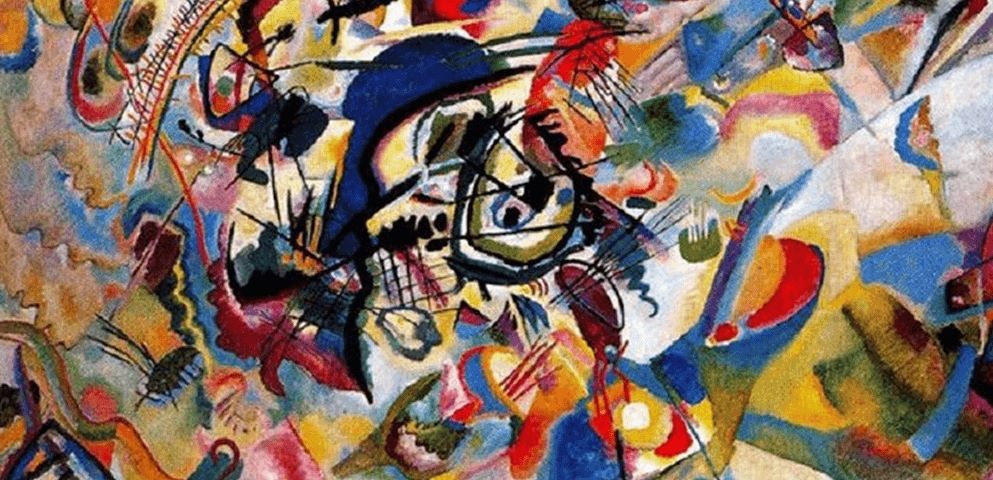
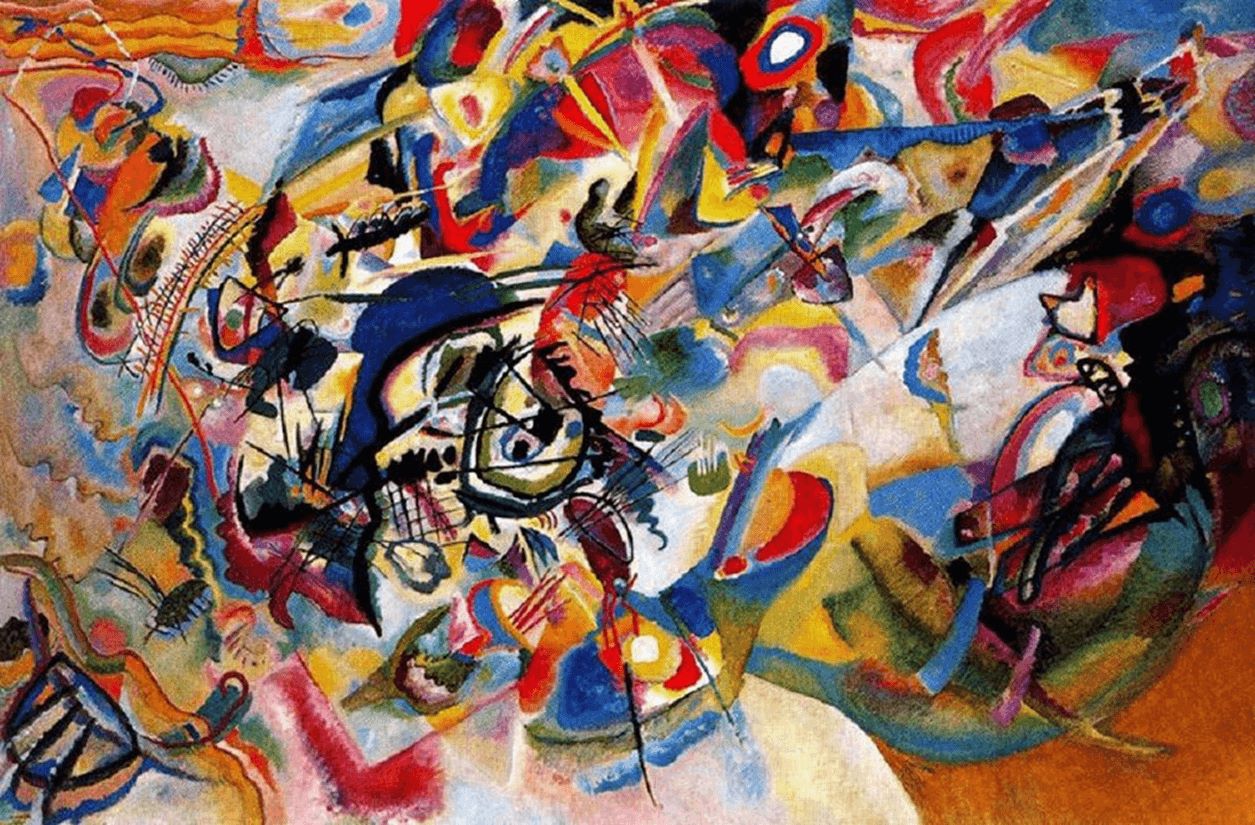
Composition VII
What was your first impression when you saw this painting? Maybe the same as me – noisy, chaotic, without regularity. However, you may take it as a random application of various colors and feel curious about how this is done at the same time: the use of color and line is extremely complex: crayon-like lines, light smudges, thicker blends between colors, thick blocks, all kinds of shapes, and combinations of them. This is definitely not an ordinary "random sketch", but there is a certain plan and operation.
However, if you look closely at these color blocks, can you find a certain pattern? When I observe, I found that the colors on the left side of the picture were more complex, with denser lines and color blocks, and lighter colors. The color block on the right side is larger and darker; There is an area in the middle where a lot of colors and lines are clearly gathered. Can we think of it as the visual center of gravity of the painting? Is it dense in a specific form? In my observation, I gradually discovered the snail-shell-like "subject" in the picture: starting from the orange-red color in the lower right corner, a wave of color gushed out, surged upwards, and then fell inward. This stream contains various circles, irregular shapes twisted based on rectangles and triangles, black and other colored lines. This stream is not a closed snail shell: it pours into the more complex background on the left, blending with the lines and colors on the left.
Color blocks are stacked on top of each other, crowding forward, and noisy sounds are pouring out from them. The diverse colors give this sound a different rhythm, as if different voices are shouting. Compared with pure paintings, the design carried by this picture gives people a musical atmosphere. Each color represents a sound—a person, or a musical instrument; They mingle together and result in a majestic episode.
This Composition No. 7 is the largest work of art by Wassily Kandinsky, measuring 200cm*300cm (perhaps imagine how shocking it would be if it were placed in front of you). It is considered Kandinsky's pinnacle before WWI. Indeed, compared to his previous compositional series, this one uses the most colors, the most complex construction. There are more than 30 watercolors and oil sketches that set the stage for this work, but the composition took only 4 days. The artist insists on not having any material source of subject matter or form at the beginning of his creation. This echoes with "inner inevitability" he mentioned in "Concerning the Spirit of Art": in the book, he argues that art should express the spirit, not imitate the outside world. This abstract work, which makes up 7 and the same series, is his attempt to express his inner spiritual world.
Kandinsky is an artist who started halfway. At the age of 30, he gave up his teaching position in law and economics and went to the Academy of Arts in Munich. His artistic journey was caused by music. Kandinsky said he had synaesthesia: when he listened to a symphony, colors came to his mind, and color was the way he used to describe music. In "Spirit in Art", he pointed out that music and art can be related in the human mind: "Color is the key, the eye is the hammer, the heart is a piano with many strings, and the artist is the hand that plays the piano." He believed that great art and music should capture the personality of the artist and the characteristics of their time, and express the human spirit in this way. In "See What You're Missing: 31 Ways Artists Notice the World — and How You Can Too", Will Gompertz points out that Kandinsky taught people how to see with their eyes and ears at the same time, and it can be said that he was creating a more comprehensive and immersive spiritual experience with abstraction.
2)
(The following text can only be used as an idea to understand abstraction, but cannot be used as a strict reference)
How can you learn about a chocolate peanut-flavored Magnum?
We can describe its appearance, observe its external shape; You can also write the ingredient list on its plastic packaging. But if we want to get to know it in more depth, we may have to take a bite of its chocolate crust, feel the chocolate crisp and peanut's taste, and then eat it layer by layer until we fully understand its structure, taste, and even evaluate it.
We'll see the Magnum first and then eat it, and in the process of eating, we develop a deeper understanding of the Magnum. We taste the layers of ingredients in Magnum and feel its rich taste. What if you compare the process of appreciating "Composition 7" with the process of eating a Magnum? When we resonate with Composition 7, we stop in front of the work and observe and analyze it more closely until our thoughts fully enter the picture. Only by eating the Magnum layer by layer can we achieve a very comprehensive understanding of the Magnum; In the same way, the analysis of elements in art can lead to the internal rhythm of the artwork, such as the analysis of the visual elements in the picture in the previous article, which gradually makes people feel the internal logic of the work.
Perhaps the answer is: points, lines, surfaces, colors, and compositions.
Architecture is related to practical purposes, so scientific knowledge is its premise. Music has long had its own theory. For painters, the analysis of these elements will build the basic framework of art.
The words above is my attempt to transform the description of art science in the introduction of "Point and Line to Plane" into the most popular explanation. After the outbreak of World War I, Kandinsky returned to Russia and was invited to join the Bauhaus in 1922. He began to delve into the elements of art, and the artistic style also underwent a dramatic transformation: from active colors to precise geometric shapes and lines. In the subsequent three chapters, "Point", "Line", and "Plane", Kandinsky analyzes the functions and applications of these three basic elements in painting in great detail. These theories are not important in themselves, but by relating them to a work by Kandinsky of the same period, we can gain a deeper understanding of how he created these abstractions.
![Composition VIII]()
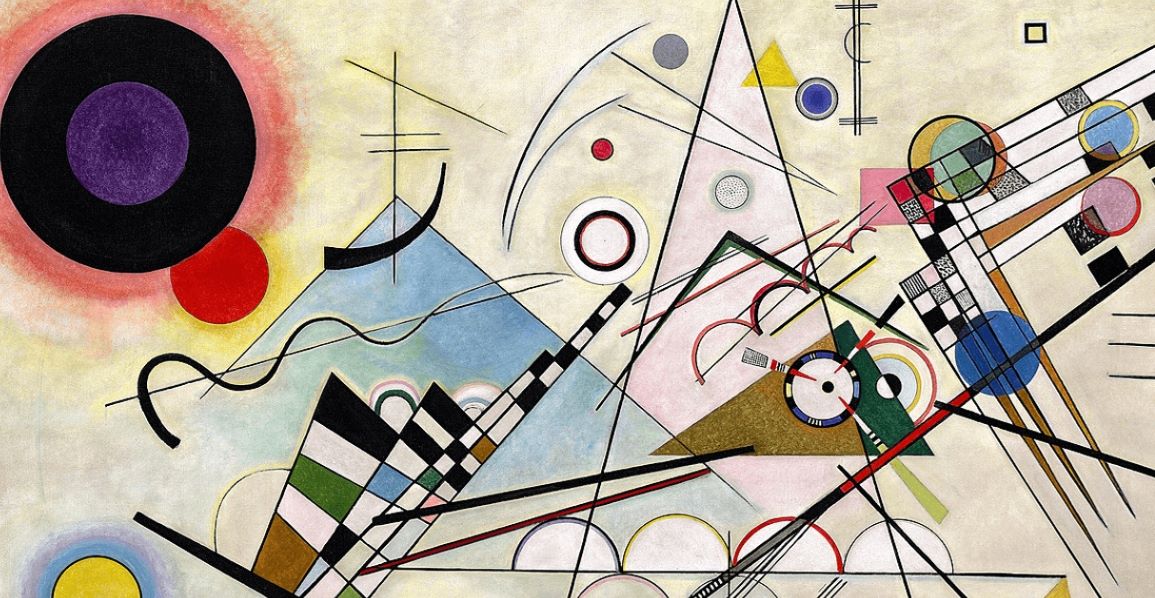
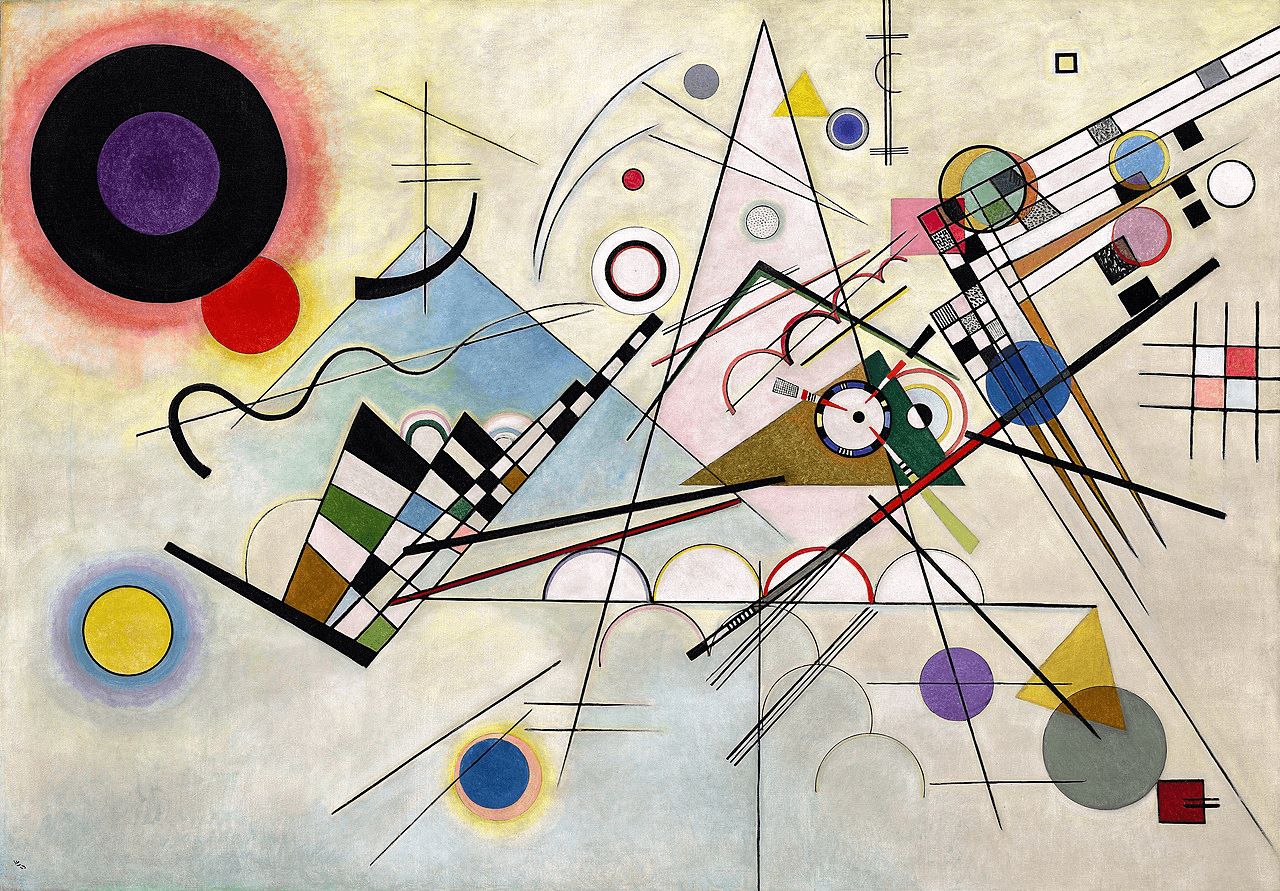
Composition VIII
Take "Component 8" as an example. What do you see in this work—one of Kandinsky's most famous works? What points, lines, and planes are included in this painting?
Perhaps there is only one point—the black dot inside the circle in the middle of the triangle on the right side of the center, and there are three very thin triangles pointing to this point. The rest are circles, and Kandinsky painted all kinds of circles: solid circles, circles with thicker outlines, from solid circles to surrounding circles, etc. In fact, in "Points, Lines, and Planes", they are closer to Kandinsky's definition of "points": not in the center, but separated from each other, many centrifugal points. At this point, the "duality of sound" appears: the absolute sound of the dot itself, the moment a colored dot appears on the picture; And where its sound is on the picture, they move closer from the edges inward or are scattered in different places. If you think of them as sounds, what may appear at this time is a jingling sound, like the music of a piano.
Then there are a large number of lines in the picture. Dense parallel lines, lines perpendicular to each other, lines that intersect vertically, lines that are not parallel but have not yet intersected...... They are not focused in the center of the picture; they are centrifugal lines. Kandinsky believed that the relationship between centrifugal lines and the picture was relatively loose, so he abandoned the still element. By analogy with sound, I think the accumulation of each line is like a moment when a violin is quickly pulled up. The two sharp corners in the center are not part of the triangle, but curves formed under the "two alternating forces". In the chapter "Line", Kandinsky points out that right angles represent justice, cold and repressed, and sharp angles represent sharpness and high activity, so the two sharp corners in the picture - the blue one on the left is close to the right angle, and the right one is a typical sharp angle - may be the combination of the painter's "sharp and highly active" inner state and his "cold and suppressed [state] skillful technique". In addition, there are a large number of semicircles or arcs in the painting. This arc is formed by "two forces acting at the same time". There are only two curves in the picture - the curve from the left, the former is more irregular and arbitrary, and the latter is less tense.
From the overall layout of the picture, the elements in the upper half are denser and the colors are more complex; The lower half has less space and fewer elements. This is closer to what the author considers to be a state of "equilibrium": in the freer upper part, the weight of individual elements is reduced, but the density is greater; And in the denser, heavier lower part, the movement of the elements is no longer free, and the movement is restrained.
In fact, at this point, even without delving into his theory, the reasons why Kandinsky became the father of abstraction gradually became clear: the visual elements he used had certain regularities and were highly variable, and there were many different ways to combine similar elements. There are a large number of short lines, long lines, colored dots, squares, very thin triangles, arcs, and curves, but the overall picture has some hidden patterns rather than being purely chaotic. In fact, these visual elements are complex enough to create a mess by themselves without any arrangement. Real casual painting couldn't present neither such diverse elements but are internally connected visual elements nor such coordinated, rich, and harmonious content. However, through his arrangement of things, these elements are placed very freely and arbitrarily peacefully. The laws implied in these complex contents explain why his abstract art has become a system. When analyzing these elements that have nothing to do with real life, people can enter areas that have nothing to do with the figurative world, so as to gain spiritual relaxation.
Of course, not everyone can appreciate the charm of abstract art, just as not everyone will like a writer's style - or, as the saying goes, the difference in aesthetic taste is not equal to aesthetic levels. These explanations could be a way of trying to understand abstract art, and it can also be a way to keep people who don't like abstract art away from it. However, whether we like it or not, this process of careful observation and the discovery of the inner laws beneath every seemingly irrational appearance is always extremely necessary.
It is the ability to see and perceive.